
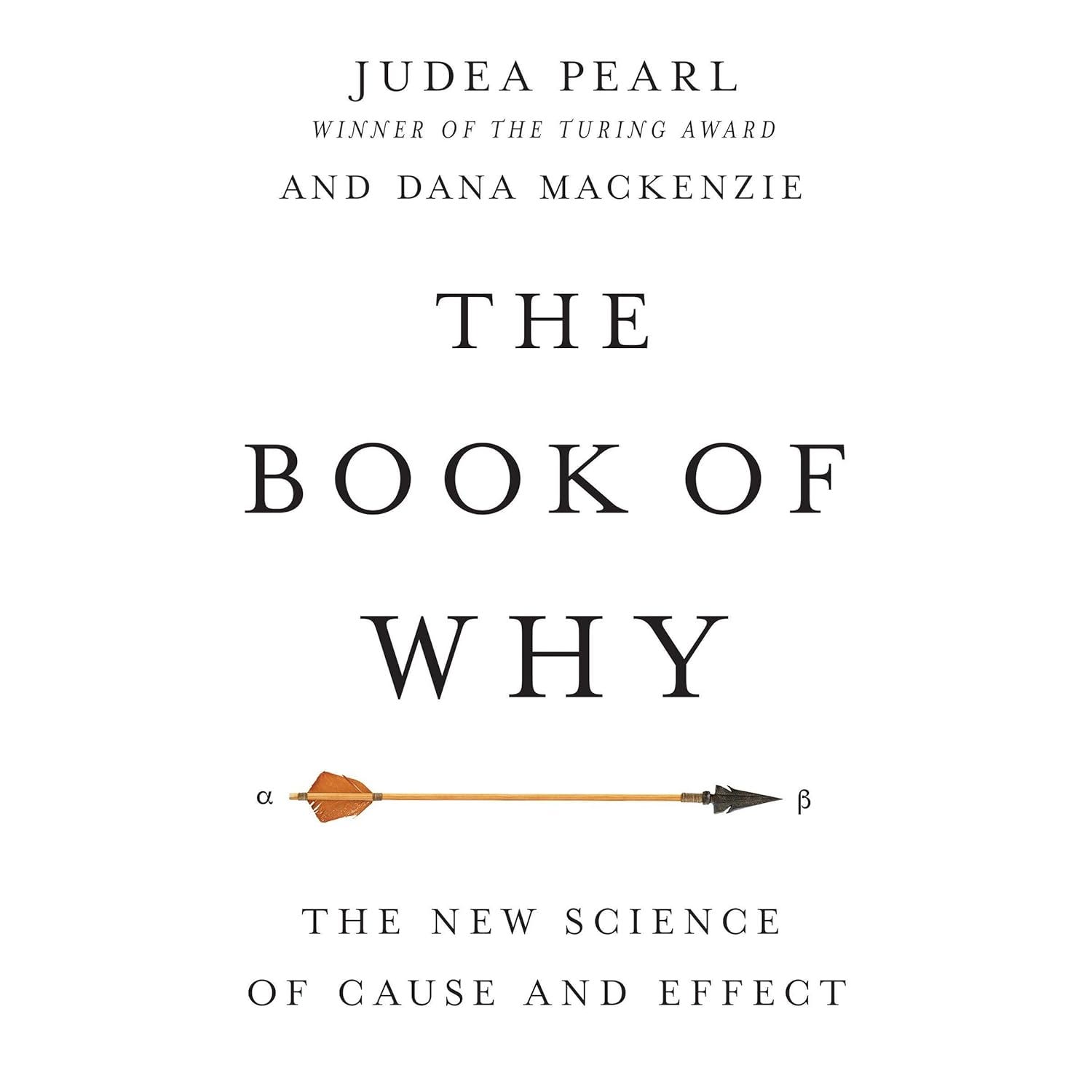
The Book of Why is one of the most important methodological works of the past three decades. That sentence should be stated without qualification before the criticism begins, because what follows is not dismissal but the kind of engagement a book this ambitious invites and deserves — and because the book’s central claim is so strong that it requires exactly this treatment: state it clearly, then ask whether it delivers.
Pearl’s argument is this. Science spent a century asking the wrong questions — not because scientists were incompetent, but because the language available to them was constitutively incapable of expressing what science actually wants to know. Causal questions require causal vocabulary. The do-operator, the causal diagram, the three rungs of the Ladder of Causation — these are not optional enhancements to the statistician’s toolkit. They are the minimum equipment required to ask whether smoking causes cancer, whether a drug is effective, whether a policy intervention will achieve its aims. Without them, science is not merely imprecise. It is systematically answering a different question than the one it thinks it is asking.
This is a strong claim. It is also, over three hundred pages, a largely correct one.
The Historical Argument
The book’s most powerful instrument is its historical account of how statistics came to exile causation from scientific discourse. Pearl’s reading of the Galton-Pearson transition is a diagnosis rather than a history. The founders of modern statistics were not merely ignorant of causation; they were actively hostile to it. Pearson’s declaration that correlation is a category broader than causation, of which causation is merely the limiting case, was not methodological modesty. It was a philosophical coup. It removed from scientific discourse the one concept without which half of scientific questions cannot be stated.
The consequences, Pearl argues, included decades of confused tobacco litigation, epidemiological debates about confounders that were really debates about causal diagrams, and a culture of data analysis that could describe patterns without ever explaining them.
Against this backdrop, Sewall Wright’s path diagrams emerge as the first genuine breach in the statistical establishment’s defenses. What Wright achieved in 1920 was the first mathematical bridge between Rung 1 — observable correlations — and Rung 2 — causal effects. The establishment’s response, Niles’s savage rebuttal, Fisher’s long-running feuding, the virtual disappearance of path analysis for four decades, is one of the more disheartening episodes in the history of science. Pearl tells it well, and with appropriate indignation. He wears his Whig historian badge without apology, and rightly so. There is no other way to understand how statistics became a model-blind data-reduction enterprise except by retelling the story in the light of the new science. Mainstream historians, lacking causal vocabulary, marvel at the invention of correlation and fail to note its casualty: the death of causation.
The Technical Core
The book’s technical core — the backdoor criterion, the do-calculus, the front-door formula, the mediation formula — forms an unusually coherent logical structure. Each tool addresses a specific obstacle to climbing the Ladder of Causation, and together they constitute an inference engine: a system that takes assumptions, queries, and data and produces causal answers.
The completeness theorems, proved by Pearl’s students, confirm that the do-calculus is not merely powerful but exhaustive. If an effect is not identifiable using its three rules, it is not identifiable at all from observational data. This is genuine intellectual achievement. The front-door formula in particular is remarkable. It demonstrates that a causal effect can sometimes be extracted from purely observational data even when the confounders cannot be measured, provided the causal mechanism passes through a mediating variable shielded from the confounders’ influence. That this is possible at all — that mathematics can sometimes do what randomization was thought to be the only alternative to — is surprising enough to justify Pearl’s occasionally triumphant tone.
The treatment of confounding is similarly clarifying. Pearl’s central move — defining confounding not as a statistical phenomenon but as a causal one, specifically as any discrepancy between the observational probability P(Y|X) and the interventional probability P(Y|do(X)) — cuts through what had been a century of definitional muddle. The backdoor criterion turns what generations of epidemiologists treated as a matter of judgment into a routine puzzle solvable by graphical inspection. The games in Chapter 4 are genuinely pedagogical. They earn their designation: what appeared intractable becomes mechanical once the diagram is drawn and the paths are traced.
The Hole Beneath the Ladder
And yet there is a hole beneath the ladder.
The entire apparatus is conditional on the causal diagram. The diagram is assumed, not derived. It encodes the researcher’s beliefs about the causal structure of the world: which variables influence which others, which pathways exist, which do not. Given a correct diagram, Pearl’s tools are provably correct. Given an incorrect diagram, they are provably wrong.
Pearl acknowledges this, repeatedly and honestly. He does not claim to have solved the problem of causal discovery — the problem of inferring the correct diagram from data alone. He presents the diagram as representing the consensus belief of researchers in a field, and notes that diagrams can be tested against data via the d-separation property: missing arrows imply testable conditional independencies. These are genuine safeguards.
But they are not sufficient safeguards for the kinds of problems the book is most ambitious about — complex social, economic, and biological systems where the causal structure is precisely what is disputed. The smoking-cancer debate, to which Pearl returns repeatedly, was partly a dispute about what the causal diagram looked like. Fisher’s smoking-gene hypothesis was a claim about the diagram, not the data. The diagram-dependence of all Pearl’s tools means that the hardest cases — the ones where the causal model is genuinely uncertain — are exactly the ones where the inference engine is most vulnerable.
This limitation reflects something deep about the nature of causal claims. The do-operator expresses an intervention on a variable, removing all incoming arrows. But all incoming arrows can only be specified once you know the diagram. And the diagram is an encoding of scientific commitment, not a derivation from data. You cannot climb the Ladder of Causation without first deciding what the ladder is attached to.
Pearl’s response to this objection is pragmatic rather than philosophical: making your assumptions transparent, in the form of a diagram, is infinitely better than concealing them in the positivist fiction that data speak for themselves. This is correct. A causal claim made with an explicit diagram that can be criticized, tested, and revised is epistemically superior to a causal claim smuggled in through an adjustment procedure whose assumptions remain implicit. The causal revolution is a revolution in transparency even more than in methodology.
But transparency is not validity. A researcher can be completely explicit about a diagram that is completely wrong. In social science particularly, where experiments are largely infeasible and the causal structure of institutions and behaviors is deeply contested, the production of plausible diagrams often conceals rather than displays the hardest scientific judgment calls. The book would have benefited from more extended treatment of what to do when the diagram itself is the site of disagreement.
The Final Chapter
The discussion of machine learning and strong AI shares this structure: technically impressive on the formal side, less convincing on the epistemological. Pearl argues that deep learning systems are limited to Rung 1 of the Ladder — they can predict patterns but cannot answer interventional or counterfactual questions — and that strong AI will require causal models. Both claims are correct. But the path from causal models are necessary to we can build machines that have them passes through the same diagram-acquisition problem. A robot that can answer causal questions given a correct model is impressive. A robot that can construct the correct model from experience is the actual scientific challenge, and it remains unsolved.
The final pages, on free will and moral robots, move faster than the argument can support. The claim that empathy and fairness follow from self-aware counterfactual reasoning is asserted rather than demonstrated. The hard problem of translating formal causal machinery into genuine moral judgment — as opposed to a system that mimics moral judgment from the outside — is not addressed. Pearl is not wrong that counterfactual reasoning is a prerequisite for moral agency. He does not show that it is sufficient.
Verdict
Pearl has done something rare: identified a deep structural problem in scientific methodology, formulated it precisely, developed a suite of tools for addressing it, proved theorems about their completeness and limits, and communicated the whole enterprise with clarity and narrative force.
The correct approach for practicing scientists is neither to accept the framework uncritically nor to dismiss it as philosopher’s mathematics. It is to treat the causal diagram as the most important scientific commitment in any analysis — to draw it before looking at the data, to subject it to expert criticism, to test its testable implications, and to report results with explicit acknowledgment of what the diagram assumes. This is the practical upshot of the causal revolution: not a new algorithm but a new discipline of assumption-making.
The book that emerges fully from that discipline has yet to be written. The Book of Why is its indispensable foundation.
Tags: causal inference, philosophy of science, statistics, do-calculus, causal diagrams, confounding, Judea Pearl, Sewall Wright, Ladder of Causation, Tier 4 plausibility auditing, observer-relative computation, syntax vs semantics, theorist.ai
This piece is part of the ongoing argument at Theorist.ai — a dedicated home for the question of what education owes the next generation of thinkers, at the precise moment when machines have become genuinely good at answering questions and genuinely poor at knowing which questions are worth asking.